USA Visa Interview Update 2026: What Changed for F-1 Students?
Reviewed/Updated on: 21 August 2026
Author: Clear My Udaan
Quick Summary
The U.S. Department of State updated its instructions for nonimmigrant visa applicants on 15 July 2026.
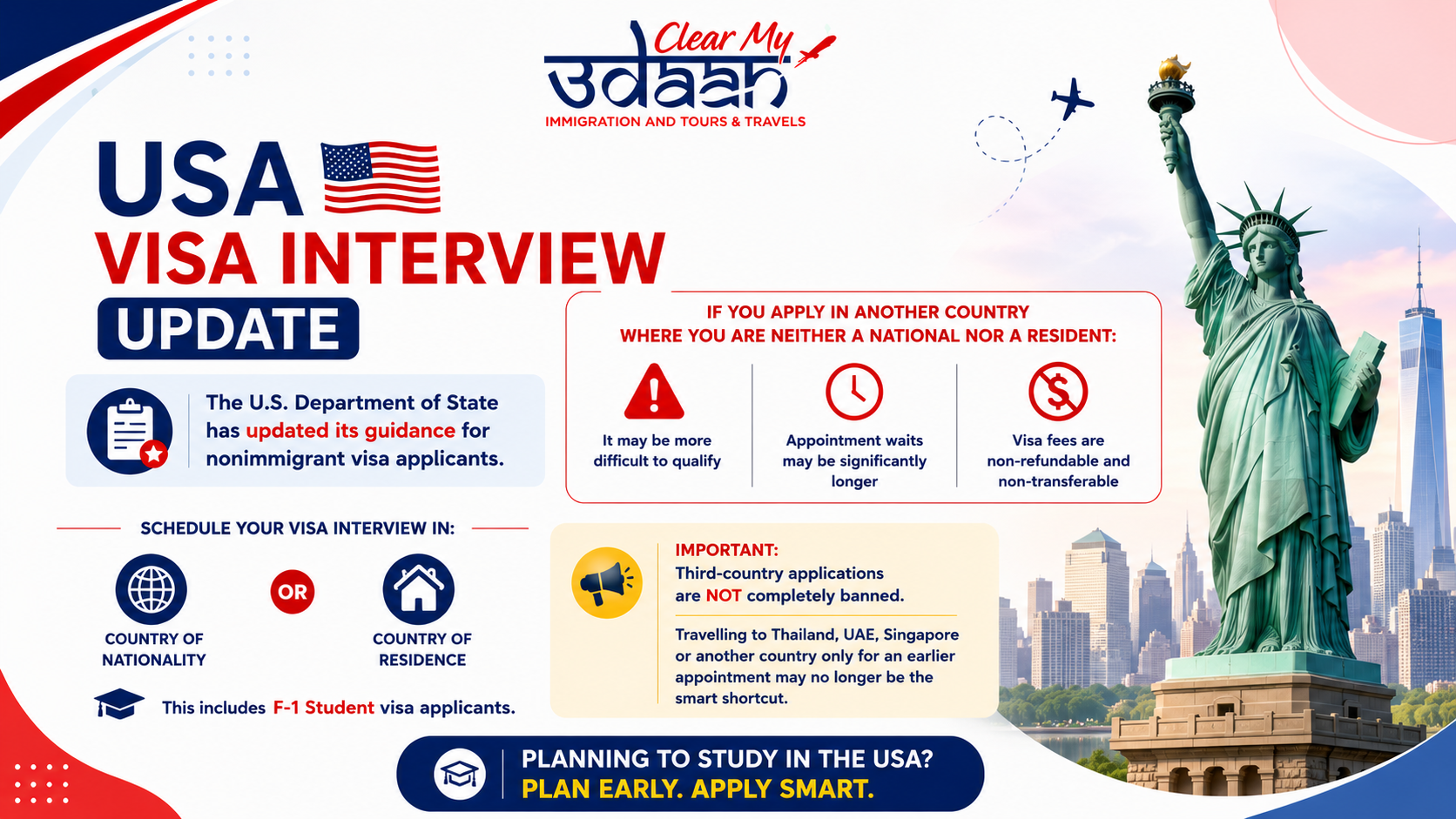
Applicants should schedule their U.S. visa interview at an embassy or consulate in their country of nationality or country of residence. If an applicant chooses a country based on residence, they should be able to demonstrate that they genuinely reside there.
For Indian students, this means travelling to countries such as Thailand, Singapore or the UAE only because a faster U.S. visa appointment appears to be available there may now create additional complications.
Importantly, the official announcement does not state that all third-country visa applications are completely banned. However, the State Department warns that applicants interviewing outside their country of nationality or residence may find it more difficult to qualify, may face significantly longer appointment waits, and cannot transfer or recover the visa fee paid for that application.
The guidance applies to all nonimmigrant visas, so it includes F-1 student visas. The Department of State separately confirms that F visas are used for academic study at universities, colleges and other qualifying academic institutions.
USA Visa Interview Rule: What Has Changed?
On 15 July 2026, the U.S. Department of State published updated instructions for people scheduling nonimmigrant visa interviews.
The Department says applicants should schedule their interview at a:
- U.S. Embassy or Consulate in their country of nationality, or
- U.S. Embassy or Consulate in their country of residence.
The July update also makes several practical consequences especially clear.
IssueOfficial U.S. guidanceWhere should you interview?Country of nationality or residenceApplying based on residenceYou should be able to demonstrate residenceThird-country applicationNot described as a blanket ban, but may be more difficult to qualifyAppointment waiting time abroadApplicants outside nationality/residence should expect significantly longer waitsVisa feeNon-refundable and cannot be transferredExisting appointmentsGenerally will not be cancelledExceptionsLimited categories plus rare humanitarian, medical or foreign-policy exceptionsAn important clarification
This should not be interpreted as the United States suddenly banning every visa application submitted in a third country.
Current Department of State pages already direct nonimmigrant applicants toward the country where they live or hold nationality. The 15 July 2026 notice updates and reinforces those instructions, while clearly explaining residence evidence, fees, longer waits, existing appointments and exceptions.
Does This Apply to F-1 Student Visas?
Yes.
An F-1 visa is a U.S. nonimmigrant visa, so the updated nonimmigrant visa interview instructions apply to F-1 applicants as well.
The U.S. Department of State identifies the F visa as the appropriate category for academic study at universities, colleges, high schools, seminaries, conservatories and certain other academic institutions.
For a typical Indian student planning a Bachelor's, Master's or PhD programme in the United States, the practical message is therefore straightforward:
If you are an Indian citizen living in India, India should normally be your first choice for your F-1 visa interview.
What About Indians Living Outside India?
Nationality and residence are different.
For example, an Indian citizen who genuinely lives in the UAE because of work, family or another valid residence status may be able to apply at the relevant U.S. mission there based on residence.
However, the Department of State says that when the application location is based on residence, the applicant must be able to demonstrate residence in that country.
Simply visiting a country as a tourist is not the same thing as residing there.
Can Indian Students Still Apply for a U.S. Visa in Thailand, Singapore or the UAE?
This is where the distinction between official fact and professional guidance is important.
OFFICIAL FACT
The Department of State does not describe third-country nonimmigrant visa applications as universally prohibited.
Instead, it specifically warns that applicants scheduling an interview outside their country of nationality, residence or designated processing post might find it more difficult to qualify for the visa.
It also says such applicants should expect significantly longer appointment waits, while fees paid for those applications are non-refundable and cannot be transferred.
CLEAR MY UDAAN GUIDANCE
For an Indian student who lives in India, travelling to Thailand, Singapore, the UAE or another country only to chase an earlier F-1 appointment is generally not a strategy we would recommend without carefully evaluating the individual case.
A faster-looking calendar does not necessarily mean a faster, simpler or stronger visa application.
Where you interview can now create questions around:
- why you are applying there,
- whether you actually reside there,
- appointment availability,
- additional travel costs,
- your ability to manage delays,
- and the overall practicality of the application.
This is professional application-planning guidance from Clear My Udaan, not a statement that U.S. law automatically refuses applicants who interview outside India.
What Happens to Existing U.S. Visa Appointments?
Students who already have an appointment should not automatically assume it will be cancelled.
The Department of State says existing nonimmigrant visa appointments will generally not be cancelled.
It also notes that specific appointments may occasionally be cancelled at particular posts, in which case affected applicants should be notified.
Therefore, students who already hold an overseas appointment should check the specific embassy or consulate's instructions before cancelling, rebooking or paying another fee.
Will Applying in Another Country Give You a Faster Appointment?
Not necessarily.
The State Department explicitly warns applicants applying outside their country of nationality or residence to expect significantly longer appointment waits.
Visa appointment availability can also change frequently.
The Department's Global Visa Wait Times page says embassies and consulates regularly add new appointments and that the published waiting periods are estimates rather than guarantees. As of its 17 August 2026 update, applicants are also advised to continue checking the scheduling system because earlier appointments may become available.
That means students should not make an expensive international trip solely because they saw an apparently earlier date at another post without understanding the risks.
What Should Indian F-1 Students Do Now?
OFFICIAL REQUIREMENTS
Students should follow the Department of State's instructions, including applying through the appropriate U.S. Embassy or Consulate and completing the normal student visa process.
For F-1 applicants, this typically involves receiving an I-20 from a SEVP-approved institution, registering in SEVIS, completing the DS-160, paying applicable fees, scheduling the visa appointment and attending the required interview.
CLEAR MY UDAAN GUIDANCE
Indian students preparing for upcoming U.S. intakes should:
- Start the visa process as early as eligibility allows.
- Prioritise appointment options in India if India is your country of residence.
- Keep your DS-160 details accurate and consistent.
- Prepare genuine financial evidence.
- Be clear about your university, programme and academic progression.
- Understand how the programme fits your career plans.
- Avoid changing interview locations only because another country's calendar temporarily looks faster.
- Check official embassy and Department of State pages before making any booking decision.
The aim should not simply be to get the earliest interview.
The aim should be to submit the application through the most appropriate location with a clear, consistent and credible student profile.
Can New F-1 Visas Be Issued Early?
Yes.
According to the official U.S. student visa guidance, new F and M student visas may be issued up to 365 days before the programme start date.
However, a new student normally cannot enter the United States more than 30 days before the programme start date shown for their studies.
This is another reason students should plan ahead rather than wait until the final weeks before their intake.
Documents Students Should Prepare Carefully
The Department of State lists core student-visa documentation including a valid passport, DS-160 confirmation page, applicable fee receipt, photograph and Form I-20.
A consular officer may also request evidence related to:
- academic preparation,
- how educational, living and travel expenses will be paid, and
- the applicant's intention to depart the United States after completing the course of study.
Document requirements and procedures can vary by embassy or consulate, so applicants should always review the instructions for the post where they will interview.
Examples for Indian Students
Example 1: Indian citizen living in Ahmedabad
The student's nationality is Indian and residence is India.
Recommended approach: Schedule the F-1 interview in India.
Example 2: Indian citizen genuinely residing in Dubai
The student's nationality is Indian but genuine residence is in the UAE.
Possible approach: An interview in the UAE may fit the country-of-residence guidance, but the applicant should be prepared to demonstrate residence there.
Example 3: Indian student visiting Thailand for one week
The student is neither a Thai national nor ordinarily resident in Thailand.
Official position: The Department of State warns applicants interviewing outside their nationality or residence that qualifying could be more difficult and appointment waits could be significantly longer.
Clear My Udaan guidance: Do not travel there merely because an earlier-looking slot appears online without first assessing the consequences.
Related Clear My Udaan Guide
Students preparing for the U.S. visa process can also read:
USA Student Visa Appointments 2026 – Booking and Preparation Guide
Read the Clear My Udaan USA Student Visa Appointment Guide
Editorial note: Because the July 2026 guidance is newer, any older Clear My Udaan content encouraging students to consider appointments globally should be reviewed so it does not conflict with the latest Department of State instructions.
Frequently Asked Questions
1. Has the USA banned third-country visa interviews?
No blanket ban is stated in the Department of State's July 2026 notice. However, applicants interviewing outside their country of nationality or residence may find it more difficult to qualify and should expect significantly longer waiting times.
2. Does the rule apply to F-1 student visas?
Yes. The updated instructions apply to all nonimmigrant visa applicants, which includes F-1 students.
3. I am Indian but live in Dubai. Can I apply there?
Potentially yes, because the guidance allows applicants to schedule in their country of residence. However, if you are applying based on residence, you should be able to demonstrate that residence.
4. Can I go to Thailand just because an F-1 appointment appears earlier?
The State Department warns that applicants applying outside their country of nationality or residence may find it more difficult to qualify and should expect significantly longer waiting periods. For an Indian student resident in India, Clear My Udaan would normally recommend prioritising India unless there is a strong case-specific reason to do otherwise.
5. Will my existing overseas appointment be cancelled?
Not necessarily. The Department of State says existing nonimmigrant appointments will generally not be cancelled, although specific posts may cancel appointments in individual circumstances and notify affected applicants.
6. Will my visa fee be transferred if I change countries?
The Department of State states that fees paid for applications scheduled outside an applicant's nationality, residence or designated processing location will not be refunded and cannot be transferred.
7. Can I trust the appointment wait time shown online?
Treat it as an estimate. The Department of State says appointment availability changes, additional slots are released regularly and published wait times do not guarantee an appointment within a specific period.
8. When should students start preparing for an F-1 visa?
Students should begin planning after receiving the necessary admission documentation and should avoid leaving visa preparation until the last minute. New F and M visas can be issued up to 365 days before the programme start date.
Official Sources
This article relies primarily on U.S. Government sources, because visa interview policy is determined by the U.S. Government rather than individual universities.
U.S. Department of State — Adjudicating Nonimmigrant Visa Applicants in Their Country of Residence, updated 15 July 2026
View the official Department of State update
U.S. Department of State — Student Visa: F and M Visas
View official U.S. Student Visa guidance
U.S. Department of State — Global Visa Wait Times, updated 17 August 2026
Check official Global Visa Wait Times
Final Takeaway
The biggest mistake students can make is reading the July 2026 update as either “third-country applications are completely banned” or “nothing has changed.”
Neither interpretation accurately reflects the official guidance.
The U.S. Department of State now clearly directs nonimmigrant visa applicants toward an embassy or consulate in their country of nationality or residence, requires applicants relying on residence to be able to demonstrate it, and warns of additional difficulties and significantly longer waits when applying elsewhere.
For most Indian F-1 applicants living in India, the practical approach is therefore simple:
Plan early. Prepare correctly. Prioritise your visa interview in India rather than travelling abroad solely in search of a faster appointment.
About the Author
Clear My Udaan provides study-abroad, student-visa and international education guidance to help students understand admission requirements, documentation, visa procedures and changing international education policies.
Clear My Udaan's editorial approach separates verified information from official government or university sources from its own professional application guidance so students can understand what is a formal requirement and what is a recommended strategy.
This article is for general informational purposes and should not be treated as legal advice. Visa eligibility and final decisions remain with the relevant U.S. authorities and consular officers.
Questions and
perspectives.
Comments are reviewed before appearing publicly so the conversation stays useful and respectful.
No approved comments yet. You can start the conversation.