
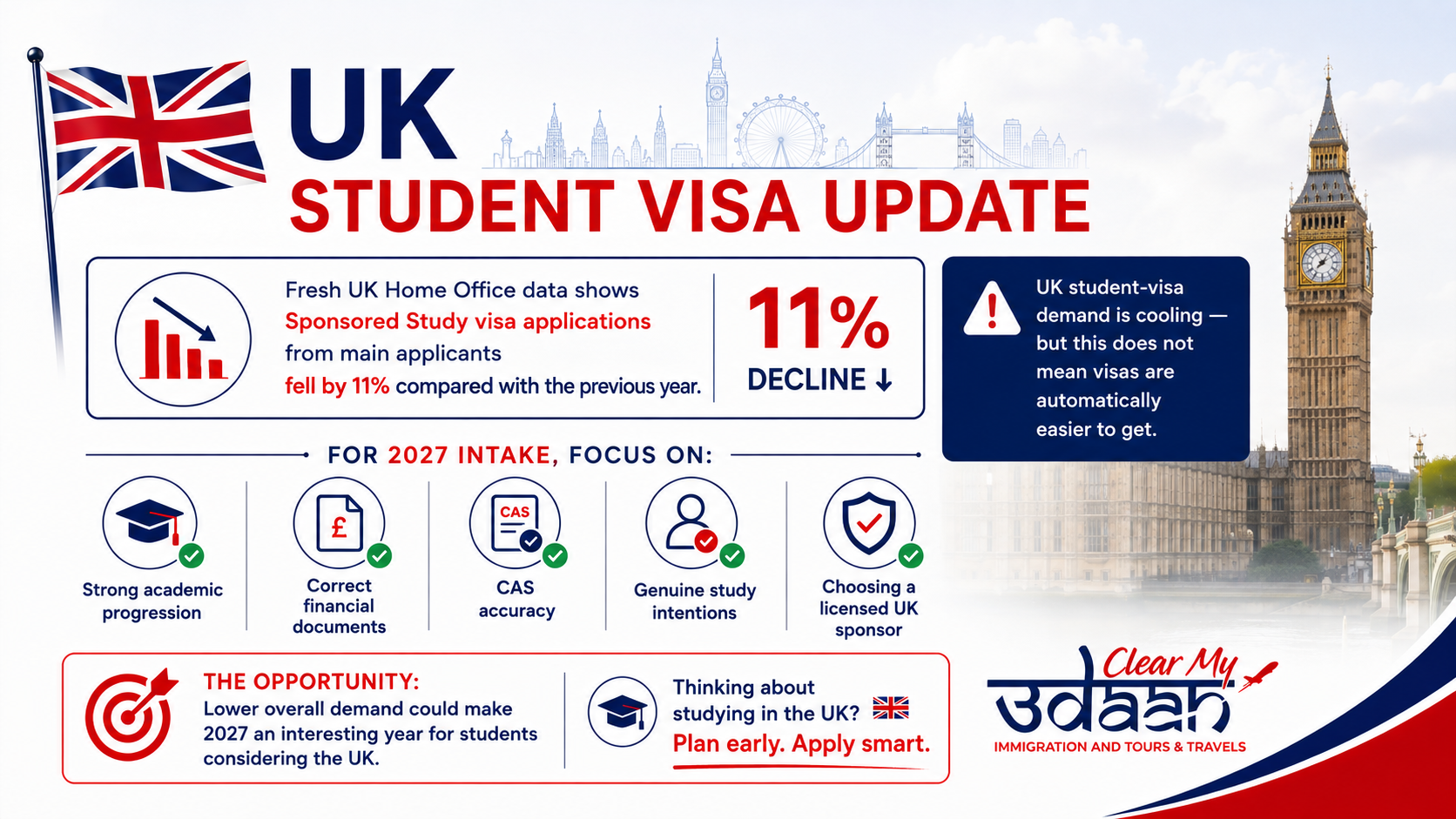
UK Student-Visa Demand Falls 11% — What Does It Mean for International Students?
The UK continues to be one of the world's most popular destinations for international education, but the latest visa figures show that demand is cooling.
According to the latest UK Home Office monthly visa data, there were approximately 381,500 Sponsored Study visa applications from main applicants in the year ending July 2026. This represents an 11% decline compared with the year ending July 2025.
For students considering the UK for the 2027 intake, the decline raises an important question:
Does lower student-visa demand mean it could become easier to study in the UK?
The answer requires some context.
UK Student Visa Applications: The Latest Numbers
The latest figures show:
381,500 Sponsored Study visa applications from main applicants in the year ending July 2026
11% year-on-year decline in main applicant applications
Approximately 19,200 applications from student dependants
Dependant applications were approximately 6% lower year-on-year
Student visa applications are highly seasonal in the UK, with application volumes normally increasing significantly ahead of the main September academic intake.
The July figures therefore provide an important indication of how international demand is developing ahead of the new academic year.
Why Are UK Student Visa Applications Falling?
There is unlikely to be one single reason behind the decline.
Several changes in the UK's international student environment have affected how prospective students evaluate the country.
1. Restrictions on Student Dependants
One major factor has been the restriction on international students bringing family members.
For courses beginning on or after 1 January 2024, most students on taught postgraduate courses can no longer bring partners or children as Student visa dependants.
Under the current rules, dependant eligibility is generally available to students who are:
Government-sponsored on an eligible course lasting more than six months, or
Studying a PhD, doctorate or qualifying research-based higher degree meeting the relevant requirements.
These restrictions have substantially changed the attractiveness of the UK for applicants who intend to study overseas with their families.
2. Students Are Comparing More Study Destinations
International students now have several destinations competing for their attention, including the UK, Australia, Canada, Germany, France, Ireland and other European countries.
Tuition fees, living costs, immigration policies, post-study work opportunities and the ability to bring dependants can all influence a student's final decision.
As a result, many students are comparing not only university rankings but the complete cost and immigration pathway before choosing a country.
3. UK Study Costs Remain an Important Factor
Students applying for a UK Student visa must demonstrate that they can meet the required tuition and living-cost conditions.
Under the current financial requirements, eligible applicants who need to demonstrate maintenance funds generally need:
£1,529 per month for up to 9 months when studying in London
£1,171 per month for up to 9 months when studying outside London
Course fees must also be covered according to the amount shown on the student's Confirmation of Acceptance for Studies, or CAS. Relevant funds normally have to meet the applicable 28-day holding requirement.
For many international families, the total cost of tuition, accommodation, living expenses, visa fees and the Immigration Health Surcharge can therefore be a major consideration.
Does an 11% Fall Mean UK Student Visas Are Easier to Get?
No.
This is probably the most important point for prospective students.
An 11% decline in applications does not mean that UKVI has reduced Student visa requirements or that applications will automatically be approved more easily.
The data measures the number of applications being submitted, not an automatic change in the standard used to assess an individual visa application.
Students still need to meet all relevant Student-route requirements.
UKVI's Student and Child Student caseworker guidance was most recently updated on 3 August 2026, including changes reflecting the Immigration Rules. The guidance continues to cover issues such as CAS requirements, licensed sponsors, eligibility, financial requirements and the genuine student assessment.
What Should International Students Focus On?
Students planning to apply for the 2027 intake should concentrate on the strength and accuracy of their own application rather than assuming that lower demand guarantees a positive visa outcome.
1. Choose the Right University and Course
Your chosen institution must be an appropriate licensed Student sponsor, and the course should make sense considering your academic background and career plans.
Students should be able to clearly explain:
Why they selected the UK
Why they selected the university
Why they selected the particular course
How the programme connects with their previous studies or career
What they intend to do after completing their studies
2. Check Your CAS Carefully
Your Confirmation of Acceptance for Studies (CAS) is one of the most important parts of the Student visa process.
Before applying, check details such as:
Course name
Course level
Start and end dates
Tuition fee
Fees already paid
University information
Academic qualifications referenced on the CAS
Errors should be corrected before the visa application is submitted.
3. Prepare Financial Documents Correctly
Having enough money is not always sufficient — applicants also need to make sure their evidence complies with UKVI requirements.
Depending on the student's circumstances, attention may need to be given to:
Required maintenance funds
Outstanding tuition fees
Bank account eligibility
The 28-day holding period
Statement dates
Source and accessibility of funds
Student loans or official sponsorship
Incorrect financial evidence can create problems even when the student genuinely has sufficient funds.
4. Prepare for Genuine Student Assessment
UKVI caseworker guidance continues to include the genuine student requirement.
Applicants should therefore understand their university, programme, career objectives and reasons for studying in the UK rather than relying on memorised answers.
A consistent application is important across the CAS, academic history, financial evidence, personal background and any information provided during an interview.
What Does the Decline Mean for the 2027 UK Intake?
The fall in overall demand could create an interesting environment for students considering the UK.
Universities that depend significantly on international recruitment may compete more actively for suitable students. However, this does not mean that every university will reduce entry requirements, increase scholarships or make admission easier.
Students should evaluate universities individually based on:
Academic entry requirements
Tuition fees
Scholarships
Location and living costs
Graduate outcomes
Course quality
Visa sponsorship status
Career relevance
The best strategy is not simply to look for the easiest admission. It is to find a university and programme that are academically suitable, financially realistic and consistent with the student's long-term goals.
Another Important Change for 2027 Students
Students considering the UK should also remember that the Graduate visa is changing separately from the Student visa application figures.
Under current UK government guidance, eligible graduates applying for the Graduate visa:
On or before 31 December 2026 can receive up to 2 years after an eligible non-doctoral course
From 1 January 2027 onwards can receive 18 months
Eligible PhD and other doctoral graduates can continue to receive 3 years.
Students starting a new UK course should therefore consider the complete study and post-study pathway when making their decision.
What Does This Mean for Indian Students?
Indian students remain an important part of the UK's international education market.
However, the headline 11% fall represents overall Sponsored Study main-applicant applications and should not be interpreted as an 11% decline specifically among Indian applicants.
For Indian students preparing for a future intake, the key message is:
Lower demand does not equal guaranteed visa approval.
A successful study-abroad strategy should still focus on:
The right university and programme
A credible academic and career plan
Accurate CAS information
Correct financial documentation
Genuine study intentions
Understanding current Student and Graduate visa rules
Is the UK Still Worth Considering in 2027?
For the right student, yes.
The UK continues to offer internationally recognised universities, a large selection of one-year Master's programmes and access to a major international education and employment market.
But students should make their decision based on their own academic profile, budget, course objectives and career plans rather than simply following overall application trends.
The latest data should therefore be viewed as an important market signal — not a guarantee of easier visas.
Final Takeaway
The headline is significant:
UK Sponsored Study visa demand is down 11% year-on-year, with around 381,500 main-applicant applications recorded in the year ending July 2026.
For prospective international students, however, the most important lesson is not that visas have suddenly become easier.
Instead, the cooling demand could make 2027 an interesting time to reassess the UK, compare universities carefully and prepare a strong, compliant application.
Planning to Study in the UK?
If you're considering the UK 2027 intake, Clear My Udaan can help you understand your university options, course eligibility, application strategy and Student visa documentation.
Plan early. Choose carefully. Apply smart.
Disclaimer: Immigration rules and visa requirements can change. Applicants should always check the latest official UK government requirements before submitting an application.
Questions and
perspectives.
Comments are reviewed before appearing publicly so the conversation stays useful and respectful.
No approved comments yet. You can start the conversation.