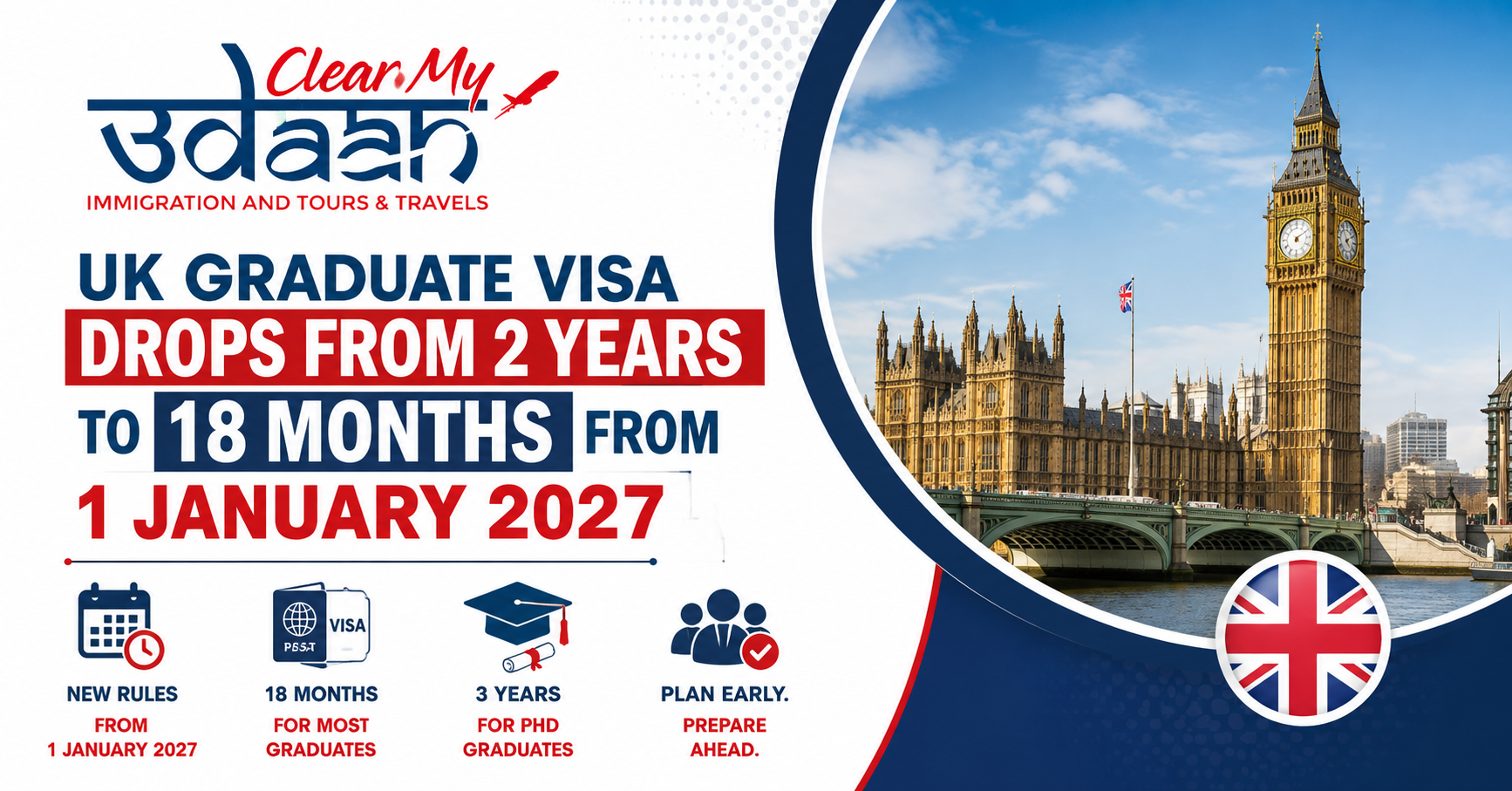
UK Graduate Visa Drops from 2 Years to 18 Months from 1 January 2027
Indian students planning to study in the United Kingdom need to prepare for an important change to the country's post-study work route.
From 1 January 2027, the UK's Graduate Visa will generally be granted for 18 months instead of the current 2 years to eligible students completing bachelor’s, master’s and other qualifying courses.
The crucial point is the date you submit your Graduate Visa application. According to official UK Government guidance, applications submitted on or before 31 December 2026 can receive two years, while applications submitted on or after 1 January 2027 will generally receive 18 months.
For Indian students considering the UK for higher education, this change makes early career planning even more important.
What Is Changing in the UK Graduate Visa?
The Graduate Visa, often referred to by international students as the UK's post-study work visa, allows eligible international graduates to remain in the UK after completing their studies.
The new duration will be:
- Application on or before 31 December 2026: 2 years
- Application on or after 1 January 2027: 18 months
- PhD or other doctoral qualification: 3 years
The three-year period for doctoral graduates remains unchanged.
This means most bachelor’s and master’s graduates applying under the Graduate route from 2027 will have six months less post-study time in the UK.
Does the Change Depend on When Your Course Starts?
No. One of the most important details students need to understand is that the change is based on the Graduate Visa application date, not simply the date your university course begins.
Official Immigration Rules state that eligible non-doctoral applicants receive two years where the Graduate application is made before 1 January 2027, while applications made on or after that date receive 18 months.
However, students cannot simply submit an application early to secure the two-year period.
To apply for the Graduate Visa, you must have successfully completed an eligible course and your university or education provider must have informed the Home Office that you successfully completed it. You must also apply before your Student Visa expires and be inside the UK when applying.
Example
Suppose a student completes a UK master's programme in September 2026 and meets all Graduate Visa requirements.
If they are eligible to submit their Graduate Visa application by 31 December 2026, the current rules provide for a two-year Graduate Visa.
But if their eligible application is submitted on 1 January 2027 or later, the Graduate Visa would generally be granted for 18 months.
Who Can Apply for the UK Graduate Visa?
Under current UK Immigration Rules, an applicant generally needs to:
- Be in the UK when applying
- Hold, or have last held, permission as a Student
- Successfully complete an eligible UK qualification
- Have studied with an eligible higher education provider
- Meet the required period of study in the UK
- Have their education provider notify the Home Office that the course has been successfully completed
Eligible qualifications can include UK bachelor’s degrees, postgraduate degrees and certain other professional qualifications specified in the Immigration Rules.
Can You Work on a Graduate Visa?
Yes.
The Graduate route remains an unsponsored immigration route, meaning you do not need an employer to sponsor your initial Graduate Visa application.
Graduate Visa holders can generally:
- Work in most jobs
- Look for employment
- Be self-employed
- Undertake voluntary work
- Travel outside the UK and return
- Continue living with eligible dependants
Graduate Visa holders cannot work as professional sportspersons and generally cannot access public funds.
Can the Graduate Visa Be Extended?
No.
The Graduate Visa itself cannot be extended. Students who want to remain in the UK beyond their Graduate Visa period will need to qualify for another immigration route.
One possible option is switching to a Skilled Worker Visa, provided the applicant and job meet the applicable requirements at that time.
The Graduate route itself is also not a direct route to settlement in the UK.
What Does the 18-Month Graduate Visa Mean for Indian Students?
For Indian students, the biggest practical difference is time.
Previously, most graduates could have up to two years after their studies to gain experience, search for employment and potentially move to another eligible work route.
From January 2027, most non-doctoral graduates applying under the Graduate route will have 18 months — six months less.
Students should therefore start career preparation earlier rather than waiting until graduation.
Students planning to study in the UK should consider:
1. Start your job search during your course
Do not wait until the Graduate Visa begins. Build your CV, LinkedIn profile and professional network while studying.
2. Research employers early
If your long-term goal is to remain in the UK, research employers and career opportunities relevant to immigration routes such as Skilled Worker.
3. Choose your course strategically
Consider employment outcomes, industry demand, practical experience, internships and university career support alongside rankings.
4. Understand your visa timeline
Know when your course finishes, when your Student Visa expires and when you are likely to become eligible to apply for the Graduate route.
5. Build UK work experience
Internships, placements, networking and relevant part-time experience during your studies can help strengthen your employability after graduation, subject to your Student Visa work conditions.
What About PhD Students?
There is good news for doctoral students.
Students who complete a PhD or another doctoral qualification will continue to receive a three-year Graduate Visa under the current rules. The reduction to 18 months applies to most other eligible qualifications.
Why Is the UK Reducing the Graduate Visa Period?
The UK Government announced the reduction as part of wider immigration reforms. It said the Graduate route should more effectively support graduates moving into skilled employment and confirmed that the post-study period for most graduates would be reduced from two years to 18 months.
The change was subsequently incorporated into the Immigration Rules.
Is the UK Still a Good Study-Abroad Option?
The UK continues to offer internationally recognised universities, a wide variety of bachelor’s and postgraduate programmes and a post-study Graduate route.
However, students considering the UK from 2027 should make their decision based on their complete study and career plan, rather than choosing a university solely because of post-study work rights.
Course quality, tuition fees, living costs, employability, location, industry opportunities and your long-term career objectives should all be evaluated before applying.
Final Takeaway
The most important dates for international students are clear:
Apply for the Graduate Visa on or before 31 December 2026 → up to 2 years for most eligible non-doctoral graduates.
Apply on or after 1 January 2027 → 18 months for most eligible non-doctoral graduates.
PhD and other doctoral graduates → 3 years.
For Indian students planning a UK education, the Graduate Visa is still an important post-study option, but the shorter 18-month period means that career preparation should begin well before graduation.
Planning to Study in the UK?
Clear My Udaan can help you understand your study-abroad options, shortlist suitable universities and courses, and plan your application journey based on your academic profile and career goals.
Contact Clear My Udaan to explore your UK study options for upcoming intakes.
Questions and
perspectives.
Comments are reviewed before appearing publicly so the conversation stays useful and respectful.
No approved comments yet. You can start the conversation.