UK Chevening Scholarship 2027–28 Applications Now Open: Fully Funded Opportunity for Indian Students
Indian students planning to pursue a master’s degree in the United Kingdom now have an opportunity to apply for one of the world’s most prestigious fully funded scholarships.
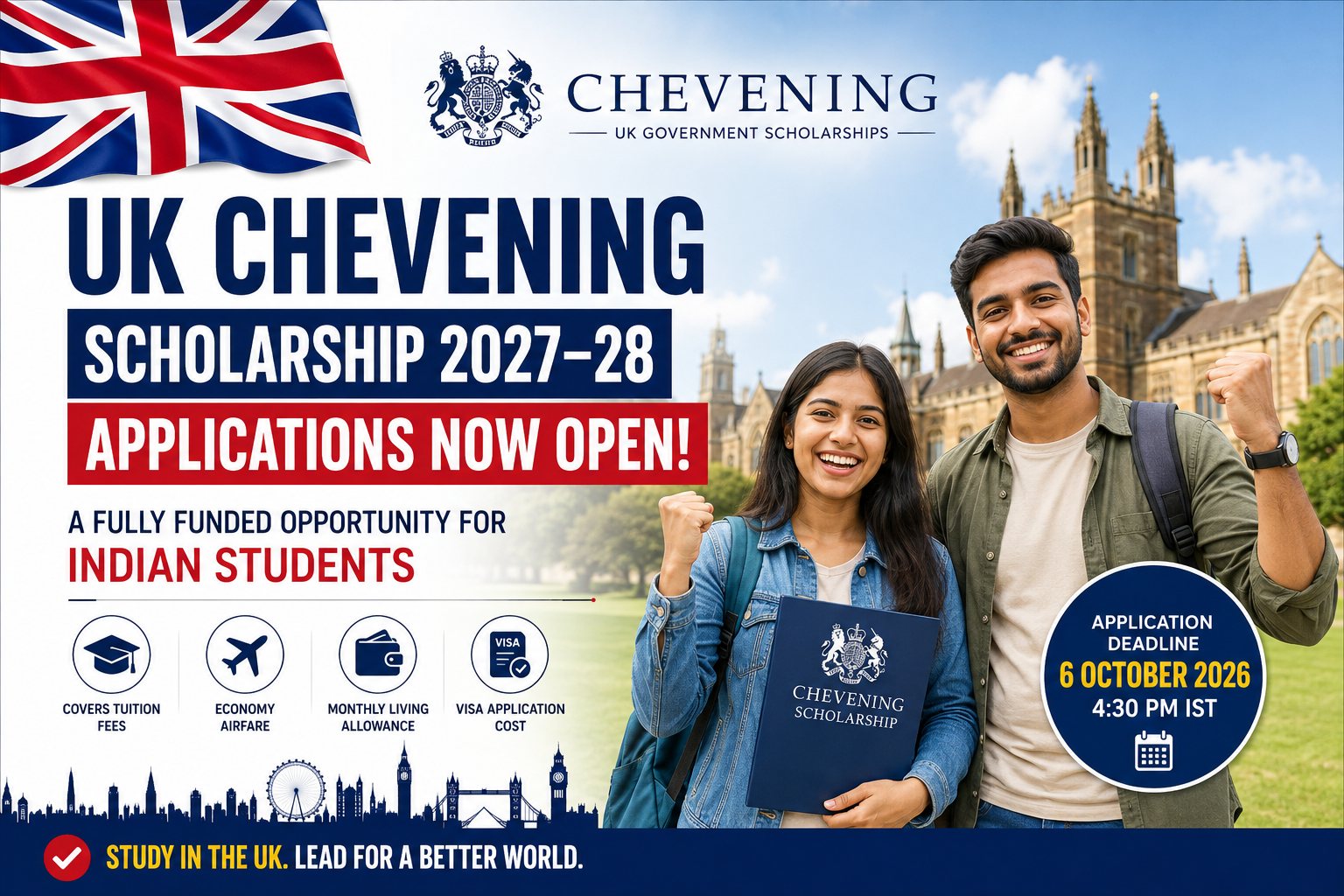
Applications for the UK Government’s Chevening Scholarships for the 2027–28 academic year opened on 4 August 2026 at 11:00 UTC, which was 4:30 PM Indian Standard Time. The application deadline is 6 October 2026 at 11:00 UTC, equivalent to 4:30 PM IST. Selected scholars will begin their studies in the UK in September or October 2027.
The Chevening Scholarship allows future leaders from India and other eligible countries to study a one-year master’s programme at a UK university while receiving financial support for tuition, travel, visa and living expenses.
Chevening Scholarship 2027–28: Important Dates
Applicants should note the following official timeline:
- Applications open: 4 August 2026 at 4:30 PM IST
- Application deadline: 6 October 2026 at 4:30 PM IST
- Eligibility screening: From October 2026
- Independent application assessment: Mid-October 2026 to January 2027
- Interview shortlist announcement: Mid-February 2027
- Interviews: March to April 2027
- Final results: From mid-June 2027
- Unconditional university offer deadline: 8 July 2027 at 5:00 PM UK time
- UK studies begin: September or October 2027
The Chevening application portal will become inaccessible once the application deadline has passed. Applicants are therefore strongly advised not to wait until the final day.
What Is the Chevening Scholarship?
Chevening is the UK Government’s international scholarship programme. It is funded by the Foreign, Commonwealth and Development Office, along with participating partner organisations.
The programme enables outstanding emerging leaders to pursue a one-year taught master’s degree in the UK. Chevening looks for applicants with leadership potential, strong professional networks, clear career objectives and a commitment to creating positive change in their home countries.
It is not simply an academic scholarship. Successful candidates also become part of an international professional and alumni network and receive opportunities to participate in academic, cultural and professional events in the UK.
What Does the Chevening Scholarship Cover?
A standard Chevening Scholarship generally provides the following financial benefits:
- Payment of eligible university tuition fees
- Economy-class travel to and from the scholar’s country of residence
- Monthly living allowance or stipend
- UK student visa application cost
- Arrival allowance
- Departure allowance
- Travel top-up allowance
- Contribution of up to £75 towards tuberculosis testing where required
- Access to Chevening networking and engagement activities
The monthly stipend depends on whether the student studies inside or outside London, and the rates are reviewed periodically. Travel and visa benefits normally apply to the scholar only.
Important MBA Fee Limit
Applicants selecting an MBA programme should be aware that Chevening applies a tuition-fee cap to MBA courses. Where the MBA tuition fee is above £22,000, the scholar may need to pay the remaining amount personally.
Chevening Scholarship Eligibility for Indian Students
An Indian applicant must satisfy all official eligibility conditions. Meeting the minimum requirements does not guarantee selection because the scholarship is highly competitive.
1. Citizenship requirement
The applicant must be a citizen of a Chevening-eligible country or territory. India is included among the participating countries.
2. Return-to-home-country condition
Successful scholars must agree to return to their home country for at least two years after completing the scholarship.
Applicants should therefore have a clear plan explaining how they will use their UK education, professional network and experience to contribute to India.
3. Undergraduate degree requirement
The applicant must hold an undergraduate qualification that allows admission to a UK master’s programme.
Applicants must have completed their undergraduate studies at least two years before the Chevening application deadline. The degree certificate will be required if the candidate progresses to the interview stage.
4. Work experience requirement
Applicants must have completed at least 2,800 hours of eligible work experience after completing their undergraduate degree.
This is approximately equal to two years of full-time employment based on a 35-hour working week. However, applicants may collect the required hours through different eligible positions and over a different period.
Eligible experience may include:
- Full-time employment
- Part-time employment
- Voluntary work
- Paid internships
- Unpaid internships
Applicants can enter up to 15 separate periods of work experience in the online application. The system calculates the total by multiplying the number of weeks worked by the average number of hours worked each week.
For the 2027–28 application cycle, official guidance states that applicants who completed their undergraduate degree after October 2024 will generally not have had enough time to fulfil the post-graduation work-experience requirement before the October 2026 deadline.
5. Three UK course choices
Applicants must select three different eligible UK master’s courses in the Chevening application.
The three options may be:
- Three courses at one UK university
- Similar courses at two universities
- Similar courses at three different UK universities
Chevening recommends selecting similar courses at different universities to increase the possibility of receiving an eligible offer.
Applicants do not need to hold a university offer when initially submitting the Chevening application. However, they must apply separately to their selected universities and receive at least one unconditional offer by 8 July 2027.
Which UK Courses Are Eligible?
A Chevening-eligible course must normally:
- Be full-time
- Be taught in the UK
- Start during the autumn term, usually September or October
- Lead to a master’s qualification
- Be a taught programme rather than a research-focused programme
- Be at least nine months and no more than 12 months in duration
The following are generally not eligible:
- Part-time courses
- Distance-learning programmes
- Courses starting in January
- Programmes shorter than nine months
- Programmes longer than 12 months
- PhD or DPhil programmes
- Research-focused MRes programmes
- Courses involving more than one month of study outside the UK
Applicants remain responsible for confirming that all three selected courses satisfy Chevening’s requirements.
Is IELTS Required for Chevening?
Chevening itself does not impose a separate English-language test requirement. However, every UK university has its own admission and English-language conditions.
Depending on the selected university and course, an Indian student may still need to provide IELTS, PTE Academic, TOEFL or another accepted English-language qualification.
Therefore, applicants should check the individual entry requirements of all three selected courses before finalising their choices.
How to Apply for the Chevening Scholarship from India
Step 1: Check your eligibility
Confirm that you meet the citizenship, undergraduate degree, post-graduation work experience, return-home and course-selection conditions.
Step 2: Research three eligible UK courses
Select three courses connected to your professional background, career objectives and the impact you intend to create in India.
Applicants should consider:
- Course modules
- Faculty expertise
- University facilities
- Industry connections
- Location
- Graduate outcomes
- How the course supports their career plan
Step 3: Register through the official Chevening India page
Applications must be submitted through Chevening’s official online application system. Paper applications are not accepted.
Applicants must register an email address and mobile number, complete the eligibility checker and save their unique application access code. This access code is required whenever they log back into the application.
Step 4: Complete the application form
The online form includes sections covering:
- Personal information
- Citizenship and immigration information
- Education history
- Work experience
- Three UK course choices
- Two referees
- Chevening essay questions
- Equal-opportunity information
Applicants can save their progress and return to the application during the open period.
Step 5: Provide two referees
Applicants must enter the names, job details and contact information of two referees.
The referees may be:
- Two professional referees
- Two academic referees
- One professional and one academic referee
A referee should know the applicant professionally or academically and must not be a friend or relative. Reference letters are generally required only if the applicant is shortlisted for an interview.
Step 6: Complete the four Chevening essays
Applicants are assessed in four principal areas:
- Leadership and influencing
- Relationship-building and professional networking
- Choice of UK courses
- Career plan and intended impact
Applicants should provide specific examples from their own employment, voluntary activities, projects or professional experience. Simply describing leadership qualities without showing measurable actions and results is unlikely to create a strong application.
Step 7: Review and submit
After submission, applicants cannot normally change their essays, course choices or work-experience information.
They should carefully check:
- Names and passport details
- Employment dates and hours
- University and course names
- Referee information
- Grammar and spelling
- Whether every question has been answered completely
Applications must be submitted before 6 October 2026 at 4:30 PM IST.
Documents Required
No documents are normally uploaded when initially submitting the Chevening application.
Applicants who are invited for an interview must upload the required documents at least seven working days before their interview. These generally include:
- Photo identification
- Official undergraduate degree certificate
- Two reference letters in English
- Other documents requested through the application portal
Chevening’s guidance specifies that the official university-issued degree certificate is required at the later stage. Applicants should keep the original document ready.
Important Warning About AI-Generated Essays
Chevening has clearly stated that applicants must write their own original essay answers.
Using ChatGPT or another artificial-intelligence tool to generate answers for the Chevening essay questions is prohibited. Applications may be screened for plagiarism, fraud and AI-generated content, and applicants may be disqualified where copied or artificially generated answers are detected.
Applicants may research the programme and understand the questions, but their personal examples, experiences, achievements and essay responses must be written in their own words.
Tips for a Strong Chevening Application
Use detailed personal examples
Instead of saying, “I am a good leader,” explain a real situation in which you identified a problem, influenced others, took action and achieved a measurable result.
Follow the STAR method
Applicants can organise examples using:
- Situation: What was happening?
- Task: What responsibility did you have?
- Action: What did you personally do?
- Result: What changed because of your actions?
Write about your individual contribution
Use “I” when explaining personal actions and achievements. Avoid giving all the credit to a team without explaining your own role.
Connect your past, course and future
A strong application should show a logical connection between:
- Your education and work experience
- The challenges you want to address
- Your three selected UK courses
- Your short-term career plan
- Your medium-term objectives
- Your long-term contribution to India
Research each course properly
Do not select courses only because a university is highly ranked. Explain which modules, teaching methods, research centres or professional opportunities will help you achieve your goals.
Start early
Applicants need time to calculate work hours, research universities, contact referees and prepare original examples. Last-minute applications often contain errors or weak, generic answers.
Common Reasons Applications Are Rejected
Applications may be rejected because the applicant:
- Has fewer than 2,800 eligible post-graduation work hours
- Selects an ineligible course
- Fails to select three eligible course choices
- Provides inconsistent employment dates
- Does not answer the essay questions fully
- Uses general statements without evidence
- Provides copied or AI-generated content
- Submits the form after the deadline
- Fails to obtain an unconditional university offer by the required date
- Does not demonstrate a realistic plan to return and create an impact in the home country
All applications are initially screened for plagiarism and eligibility. Eligible applications are then assessed by independent reading committees before shortlisted candidates are invited for interviews by the relevant British embassy or high commission.
Frequently Asked Questions
Can final-year undergraduate students apply?
Applicants must already have completed an undergraduate degree and must meet the full 2,800-hour post-graduation work-experience requirement by the application deadline. Most current final-year students will therefore not be eligible.
Is there an age limit?
No. Chevening does not have an upper age limit. Selection is based on eligibility, leadership potential, professional achievements and the quality of the application.
Can someone who already has a master’s degree apply?
Yes. Holding a master’s degree does not automatically prevent an applicant from applying for another eligible UK master’s programme.
Is an admission offer required before submitting the application?
No. Applicants may submit the Chevening application before applying to or receiving offers from their three universities. However, at least one unconditional offer must be obtained and submitted by 8 July 2027.
Is the Chevening application free?
Yes. There is no official Chevening application fee. Applicants should apply only through the official online application system. Chevening does not endorse organisations that claim they can guarantee scholarship selection.
Can dependants accompany a Chevening scholar?
A scholar’s family circumstances do not prevent them from applying. However, the standard Chevening financial package is intended for the selected scholar, and applicants should independently check current UK dependant-visa rules and additional financial requirements.
Final Advice for Indian Applicants
The Chevening Scholarship is an excellent opportunity for Indian professionals who have already demonstrated leadership, professional growth and a commitment to creating long-term positive change.
Applicants should begin by confirming their 2,800 hours of post-graduation work experience, identifying three closely related UK master’s courses and collecting strong examples of leadership, networking and measurable impact.
The final application deadline is 6 October 2026 at 4:30 PM IST. Submit well before the deadline to avoid technical problems or incomplete information.
For guidance on selecting suitable UK universities and preparing university admission applications, students may contact Clear My Udaan. Applicants must write their Chevening essays independently and in their own words.
Disclaimer: Clear My Udaan is an independent education consultancy and is not affiliated with, endorsed by or officially connected to Chevening, the Foreign, Commonwealth and Development Office or the UK Government. Scholarship rules and deadlines may change, so applicants should verify all information through the official Chevening website before submitting an application.
Questions and
perspectives.
Comments are reviewed before appearing publicly so the conversation stays useful and respectful.
No approved comments yet. You can start the conversation.