
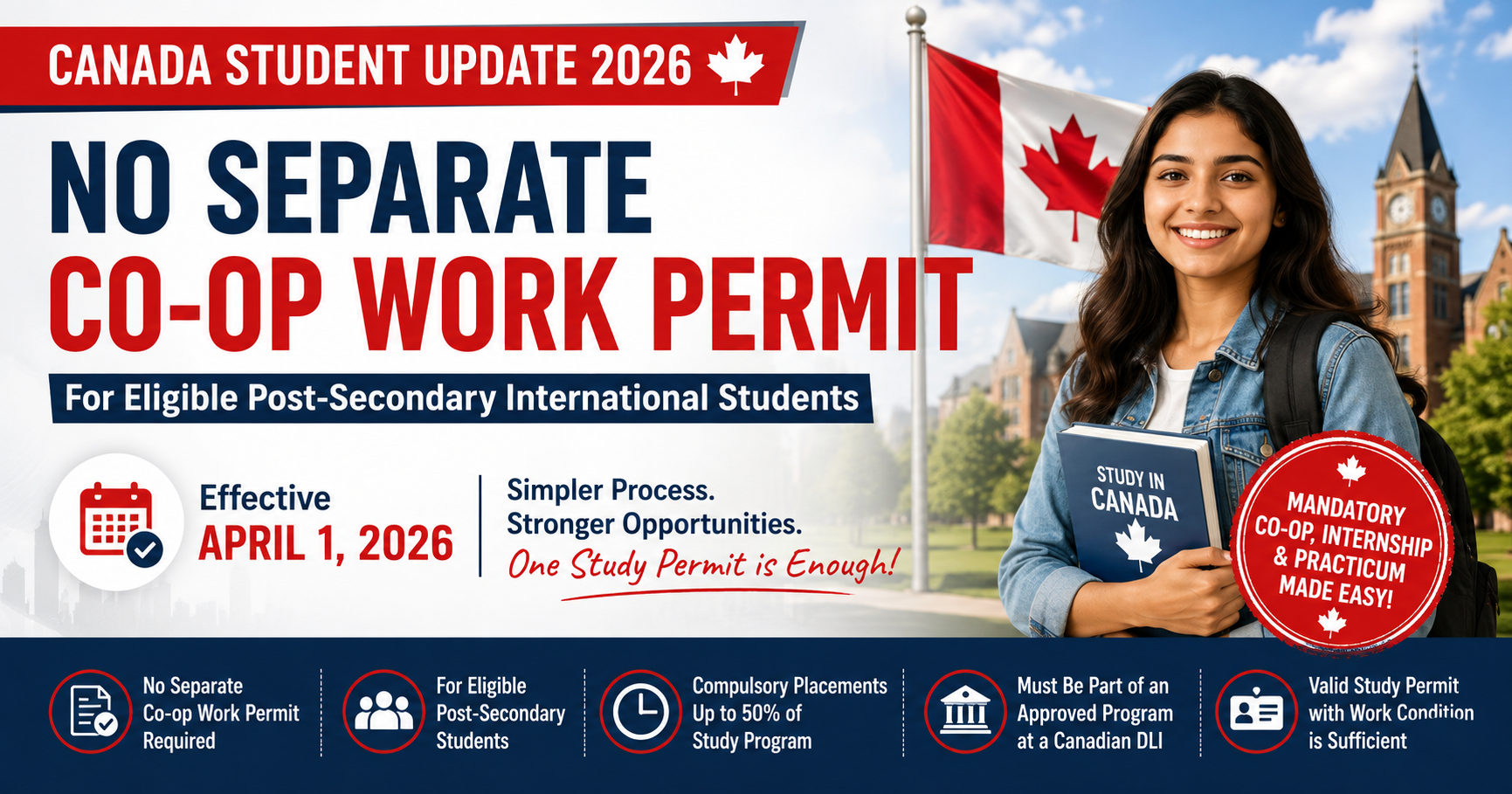
Canada Removes Separate Co-op Work Permit Requirement for International Students
Canada has introduced an important change for international students enrolled in programs that include compulsory practical training.
Effective April 1, 2026, eligible post-secondary international students no longer need to obtain a separate co-op work permit to participate in mandatory co-op placements, internships, practicums or other approved student work placements.
Students who meet all eligibility requirements can complete the required work component of their program using their valid study permit. The Government of Canada says this change removes an unnecessary administrative step and allows eligible students to complete one study program with one permit.
However, this does not mean that every international student can work in any internship without restrictions. The placement must be an official and compulsory part of an eligible study program, and the student must continue to meet all IRCC requirements.
What changed on April 1, 2026?
Previously, many international students whose Canadian study programs included mandatory work experience needed two different immigration documents:
- A valid Canadian study permit
- A separate co-op work permit
Under the new rule, eligible post-secondary students no longer need the second document for a compulsory student work placement.
The change applies to qualifying work-integrated learning activities such as:
- Co-op placements
- Internships
- Practicums
- Mentorship programs
- Other work experience required by the academic program
The employer must be approved through the student work-placement program of the student’s Designated Learning Institution, or DLI.
Who is eligible under the new rule?
A post-secondary international student must meet all applicable IRCC conditions before beginning a student work placement.
1. The placement must be compulsory
The co-op, internship or practicum must be required to complete the student’s degree, diploma or certificate.
An optional internship arranged independently by a student may not qualify under this provision.
2. The student must study at a DLI
The student must be enrolled full-time at a Canadian Designated Learning Institution in an eligible:
- Academic program
- Vocational program
- Professional training program
The provision is for students studying at Canadian institutions and not for students enrolled at institutions outside Canada.
3. A valid study permit is required
The student must hold a valid study permit or must have applied to extend the study permit before it expired.
The initial study permit must also contain an appropriate condition authorising the student to work on campus. Students whose permits do not contain the required condition may need to request an amendment before beginning the placement.
4. A letter from the institution is required
The student must obtain a letter from the DLI confirming that the work placement is a compulsory requirement of the study program.
IRCC may also request confirmation that all students in the program must complete the placement to receive their qualification.
5. The placement cannot exceed 50% of the program
The combined duration of the student’s co-op placements, internships or practicums must represent 50% or less of the total study program.
Who is not eligible?
The removal of the separate co-op work permit does not apply to every type of student or course.
Students cannot use this provision if they are enrolled only in:
- English as a Second Language courses
- French as a Second Language courses
- General-interest courses
- Courses that prepare them for admission to another program
- Courses at an institution outside Canada
Students in these categories may need another type of work authorisation before performing work in Canada.
Do secondary-school students still need a co-op work permit?
Yes.
International students studying at the secondary-school level must continue to obtain a separate co-op work permit before participating in a Canadian co-op placement or internship.
The new exemption is specifically for eligible international students studying at the post-secondary level.
Can students work for any employer?
Eligible students can work for an employer accepted by their institution’s student work-placement program, including an approved employer located off campus.
This does not provide unrestricted permission to accept placements with any employer. The placement must remain connected to the student’s study program and be approved by the DLI.
Students completing placements in hospitals, healthcare facilities or other workplaces where public-health protection is important may also require an immigration medical examination.
Is there a weekly working-hour limit for co-op placements?
IRCC states that there is no weekly hour limit for an eligible compulsory student work placement.
However, the total placement component must not make up more than 50% of the student’s overall study program.
This rule should not be confused with regular off-campus employment.
Eligible international students may generally work up to 24 hours per week off campus during regular academic terms. The separate 24-hour limit continues to apply to ordinary off-campus employment that is not part of an approved compulsory placement.
What happens to existing co-op work permits?
Students who already hold a valid co-op work permit do not need to cancel it. They may continue using the permit for its full period of validity.
Holding an existing permit does not prevent the student from completing an eligible placement.
What happens to pending applications?
International students who submitted a co-op work permit application before the rule changed generally do not need to take further action if they qualify under the new requirements.
IRCC announced that it would withdraw eligible and active pending co-op work permit applications because the applicants no longer require the separate permit. Students may also receive a letter explaining the withdrawal.
Students should continue checking their IRCC accounts for official messages about their individual applications.
Do students still need a Social Insurance Number?
Depending on the type of work involved, a student may need a valid Social Insurance Number, commonly called a SIN.
To apply for or update a SIN, the student must have the required work condition printed on the study permit. A student whose permit does not contain an acceptable work condition may need to request an amendment before applying for the SIN.
What does this change mean for Indian students?
The policy could make the process easier for Indian students choosing Canadian programs with compulsory practical training.
Potential benefits include:
- One less immigration application
- Less administrative paperwork
- Fewer delays before beginning a compulsory placement
- Easier coordination between the student, institution and employer
- A more straightforward transition from classroom study to practical experience
The change does not create additional work rights or increase the number of international students permitted to work. It only removes the requirement to obtain a second permit for an eligible compulsory placement.
Students should still evaluate the institution, program, tuition fees, location, placement opportunities and post-graduation work permit eligibility before accepting an offer.
Checklist before starting a placement
Before beginning a co-op placement or internship, students should confirm that they have:
- A valid study permit
- The required work condition printed on the study permit
- Full-time enrolment at a Canadian DLI
- A letter confirming that the placement is compulsory
- Approval from the institution’s placement program
- A placement that represents no more than 50% of the program
- A valid SIN, where required
- A medical examination, if required for the workplace
Students should not begin working until they have confirmed that they satisfy every applicable requirement.
Frequently asked questions
Do all international students no longer need a co-op work permit?
No. The exemption applies to eligible post-secondary international students completing compulsory placements that are part of their Canadian study programs.
Does the rule apply to optional internships?
Generally, the placement must be required to complete the study program. Students should obtain written confirmation from their institution before accepting an optional or independently arranged internship.
Can a student work unlimited hours in a placement?
There is no weekly hour limit for an eligible compulsory student work placement. However, the total placement must not exceed 50% of the program.
Does the new rule increase the normal off-campus work limit?
No. The regular limit for eligible off-campus work during academic terms remains up to 24 hours per week.
Do high-school students still require a permit?
Yes. International secondary-school students still require a separate co-op work permit.
Does this change affect PGWP eligibility?
The announcement concerns compulsory student work placements. It does not automatically change a student’s eligibility for a Post-Graduation Work Permit. Students must independently verify that their institution and program meet current PGWP requirements.
Final takeaway
Canada’s removal of the separate co-op work permit requirement is a positive administrative change for eligible post-secondary international students.
From April 1, 2026, qualifying students can complete mandatory co-op placements, internships and practicums without applying for an additional co-op work permit. Nevertheless, students must still hold valid status, study full-time at an eligible DLI, obtain institutional confirmation and comply with all placement conditions.
Because Canadian immigration requirements can change, students should check the latest IRCC instructions and obtain advice based on their individual circumstances before beginning employment.
Disclaimer: This article provides general information and does not constitute legal or immigration advice. Eligibility is assessed according to each student’s circumstances and the latest IRCC requirements.
Questions and
perspectives.
Comments are reviewed before appearing publicly so the conversation stays useful and respectful.
No approved comments yet. You can start the conversation.